NEWS
Where Medtech Meets Electronics: Why European Manufacturers Are Looking at Costa Rica
In November 2026, CINDE, the private, independent, non-profit agency that promotes foreign direct investment and business development in Costa Rica, is taking part in two of Europe’s most important industry shows: electronica and SEMICON Europa in Munich (November 10–13, 2026) and MEDICA and COMPAMED in Düsseldorf (November 16–19, 2026). This article collects what we shared with European medtech and electronics manufacturers and what they told us in Munich. It will be updated after MEDICA.
Ask a European manufacturer what has changed in the last five years, and two answers come up repeatedly. The products have changed: medical devices are smaller, smarter and carry far more electronics than the generation before them. And the map has changed: Europe wants to depend less on Asia for electronics manufacturing, and more European companies are building their business in the United States.
Those two shifts meet in one question: where do you build the next generation of devices for the Americas? For a growing number of European companies, part of the answer is already in Costa Rica.
 Why European manufacturers are rethinking their footprint in the Americas
A growing share of new medical device applications in the United States comes from European companies, according to RSM. For many of them, the US is already their largest market, and the strategy is shifting from exporting to it to operating close to it.
Trade policy has made that shift more urgent. Tariffs are reshaping nearshoring decisions, and supply chains that run through a single region now look like a risk rather than an efficiency. Operations leaders are building shortlists of locations that can serve the US in the same time zone, under stable rules, with talent that already knows regulated manufacturing. Costa Rica is on many of those lists, and several European companies, most of them German, have already made the move. More on nearshoring in Costa Rica.
Where medtech meets electronics
Costa Rica built its medtech cluster one layer at a time. First came the large OEMs. Then suppliers, contract manufacturers and service providers followed them, and each new arrival made it easier for the next one to come. Today, medical devices are the country’s top export, with almost US$11 billion in 2025, and the cluster is one of the most complete in the Americas (see the figures on medical device manufacturing in Costa Rica).
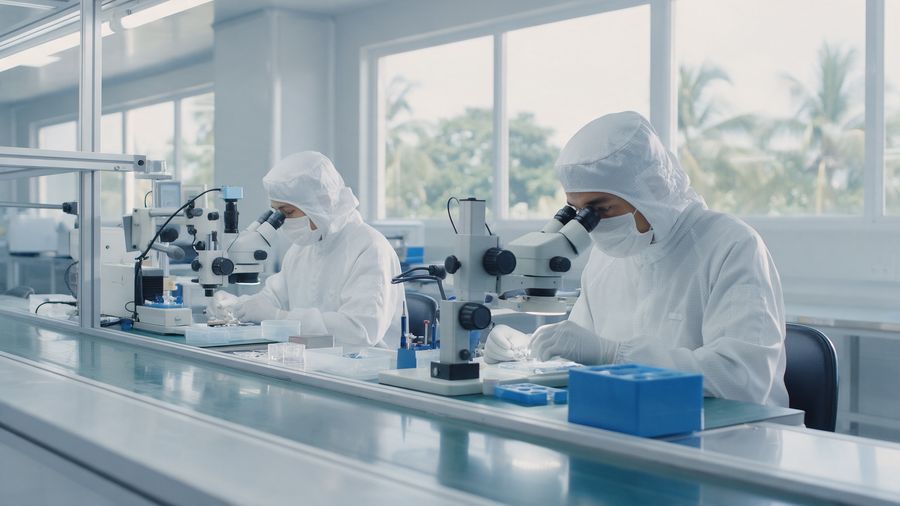
The next layer is electronics. Medical devices are getting smaller and carrying more electronics, sensors and embedded software, and electromechanical medical devices are where we see the most concrete opportunity. To build them here at scale, OEMs need electronics manufacturing services (EMS) providers, component suppliers and semiconductor assembly and test capacity nearby. That is the ecosystem we are working to grow, following the same model that built the medtech cluster.
That is also why we are at both shows, each with a different focus:
- electronica + SEMICON Europa: EMS providers, outsourced semiconductor assembly and test (OSAT) companies, and firms that design, assemble, package and test semiconductors.
- MEDICA + COMPAMED: OEMs, contract development and manufacturing organizations (CDMOs), and suppliers specialized in high-precision machining, EMS, extrusion and microelectronics.

What we heard in Munich
electronica and SEMICON Europa brought together more than 3,500 companies. Most of our conversations were with EMS providers, PCB assembly specialists, and precision mechanics, microelectronics and design companies. Three themes came up again and again:
- Europe wants to rebuild its electronics base. The region is strong in design, especially in advanced semiconductor solutions, but still depends on Asia for parts of manufacturing, and companies want to reverse that.
- The US is a bigger part of the plan. More European companies are working in the US market, especially in automotive, aerospace and automation. Integrators and equipment suppliers for semiconductor production are fully engaged in the projects under construction there.
- Cost is the hardest part. With Asia so established in the supply chain, European companies find it hard to close deals on price. Many have added operations in Asia, or rely on an established supplier there, to compete.
For many European electronics companies, Costa Rica is a new name on the global manufacturing map, and one they are keen to learn more about. Their questions were practical. Who is already building here? How can Costa Rica help them grow in the US market, especially with tariffs in play? What incentives can support their investment? Most conversations were a first introduction rather than a project already in motion, and that is where the work starts. The sections below answer the first of those questions.
Can Costa Rica absorb more companies?
It is the first question many European companies ask, and a fair one: with more than 100 medtech companies already operating in the country, is there room for one more? The track record says yes. Between 2010 and 2025, medtech exports grew at an average annual rate of 16% and employment at 12%, and there is still room to consolidate. Operations are spread across three provinces, Alajuela, Heredia and Cartago, so companies draw on different talent pools instead of competing for the same one. That has kept the industry stable as competition grows.
Will I find local suppliers?
Yes, and that is often what tips the decision. More than 60 specialized suppliers and contract manufacturers cover engineering services, laboratories and sterilization, plus plastic, metal, electronic and chemical components. Some areas still need to grow, electronics among them, and we are working to attract the companies that fill those gaps.
Beyond assembly: the engineering already happening here
European companies that come for manufacturing often stay for engineering. Several companies have built specialized engineering teams in the country, and the strongest areas today are:
- New product introduction (NPI)
- Redesign and sustaining engineering
- Testing and materials engineering
- Embedded software
Boston Scientific, Terumo and Heraeus are public examples. Research and development (R&D) has the most room to grow, mainly in manufacturing processes and product improvement.

European companies already building here
The German presence in Costa Rica’s medtech and electronics cluster has grown steadily over the past decade, and much of it is concentrated in Cartago. A few examples:
- Zollner (Germany). The bridge between electronics and medtech. The German EMS provider has operated in Cartago since 2014 and in 2026 opened a 10,000 m² expansion in the La Lima Free Zone as part of its Americas 2030 strategy, with around 500 additional jobs expected by 2030. The site serves healthcare and life sciences customers, among others.
- Freudenberg Medical (Germany). Opened its second facility in the Coyol Free Zone in 2025, a US$25 million investment to assemble minimally invasive catheters for electrophysiology, vascular and structural heart therapies. It plans to grow from 350 to more than 900 employees within three years.
- Heraeus Medevio (Germany). Expanded its Cartago operation with a third phase that will create 500 new jobs upon completion.
- G.RAU and Admedes (Germany). The group opened its fourth plant in Cartago in 2025, adding metal stamping, Nitinol tubing for cardiovascular applications, a medical-grade coating line and Nitinol subassemblies, with about 150 new jobs.
- Coloplast (Denmark). Manufactures ostomy and urinary continence care products at two plants in the La Lima Free Zone, Cartago, which account for 15–20% of its global device volume, and in 2026 added a Business Centre in San José serving its operations across the Americas.
- Philips (Netherlands). Runs its largest medical device manufacturing site worldwide from Alajuela, producing cardiovascular procedure devices, sleep apnea therapy solutions and hospital monitoring technologies, with over 16 million devices exported in 2025.
- Trelleborg Medical (Sweden). Operates its first Central American facility in the Evolution Free Zone in Grecia, offering silicone molding, thermoplastic manufacturing and device assembly in cleanroom conditions.
A view from CINDE’s Life Sciences team
“Costa Rica is one of the best options for engineering and manufacturing components and assemblies for critical industries such as medical devices and aerospace, with a mature medical device industry and an exceptional geographic position to serve the US,” said Erick Mora, Lead for Life Sciences and Advanced Manufacturing at CINDE.
Talk to our Life Sciences team
If you are evaluating a manufacturing or engineering operation for the Americas, especially one with electronic content, request a 20-minute call with Erick Mora and our Life Sciences and Advanced Manufacturing team.
Request a meeting
About CINDE
CINDE is the private, independent, non-profit agency that promotes foreign direct investment and business development in Costa Rica, and the country’s strategic investment expert and guide. Since 1982, it has guided multinational companies as they establish, expand and reinvest in Costa Rica. Recognized at home and abroad as the key private player in the country’s investment ecosystem, CINDE has helped bring more than 400 global companies to Costa Rica and has built a strong network of more than 65 strategic partners.



.jpeg)
.jpeg)
.jpeg)
.jpeg)